Ubik - Philip K. Dick

0 comments
Philip K. Dick's "Ubik" is a science fiction novel that was named by Time Magazine as one of the 100 best novels ever published since the 1920's.

It was published in 1969, but the story is set in the futuristic world of 1992 in a place called as the North American Confederation. It's a world entirely different from the 1992 that we've experienced. Philip K Dick's vision of the future is both visually stunning and wonderful.
Glen Runciter runs a corporation called Runciter Associates, a security company that employs people with the gift to block certain psychic powers (for example, an anti-telepath can prevent a telepath from reading a client's mind). The company's main rival is an organization run by Ray Hollis, who then employs people with psychic powers.

So companies hires psychics run by Ray Hollis to spy on their rivals, their rivals in turn hires Runciter's company to prevent Hollis' psychics from reading the minds of their employees and so on.

Problem arises when a big shot business tycoon Stanton Mick offers Runciter an enormous amount of money to try and to secure his company which was based on the moon from telepaths. Arriving at their lunar moon destination Runciter together with his top gun anti-psychic technician Joe Chirp, and a few other employees of the Corporation. They discover that their work assignment is a trap and that nobody was there but them.

Before they could grasp about what's happening a bomb exploded that injured Joe Chirp and his colleagues which include Pat Conley a mysterious woman who had the ability to go back in time and undo events by changing the past.

Everybody survived the blast with few injuries, everybody that is except Glen Runciter, whom they found lying on the floor dead.

Transporting Runciter's body back to Earth, the surviving members of the group starts to experience sudden shifts in reality ( like a cigarette expiring prematurely, coins becoming phased out ).

They tried to persuade Pat Conley to go back in time to change the past, but Pat tells them that she cannot do it because time had already passed.

Upon returning to Earth they went to Switzerland to put the body of Glen Runciter in "half life" form in a place called Beloved Brethren Moratorium where Ella Runciter ( Glen's deceased 20 year old wife ) is also in half-life. It is a place where dead people can spend their half-life in a dreamlike mode, and occasionally communicate with relatives through a sort of psychic intercom.

Afterwards Joe Chip assumed control of Runciter Associates, eventually finding difficulties in running the company as the group who survived the Lunar Moon blast continue to experience unexplained events like going back in time, mechanical and electrical objects like a TV set turning into an old tube radio, automobiles being transformed to a much older model, coins turning up with the image of Glen Runciter. Going to the airport all Joe Chirp can find was a biplane.

What's worst are group members who wanders differently from the rest are eventually found dead in a state of decomposition that looks like they were dead for a number of years.

And from year 1992, they find themselves in year 1939.

To add confusion to Joe Chirp and the remaining group members was the series of messages from Runciter that mysteriously appear on bathroom walls, TV commercial, traffic violations ticket and everywhere else.

It seems that Glen Runciter is alive after all.

As the group started to feel tired and the decomposition process seems inevitable Glen Runciter tells Joe Chirp about a product stored in a sort of aerosol spray called UBIK as their only way of saving themselves by spraying its contents all over their body.

Pat Conley meanwhile believes that all of these transformation was her own doing, she later confessed to Joe Chirp that she was a spy sent by Rollis to Runciter's company to ruin all of their efforts, But as Glen Runciter later told Joe Chirp this wasn't the case because Pat Conley same with the others have lost all of her powers at the time of the Lunar Moon blast.

It was at this revelation that Joe Chirp and the rest of the group entertained the possibility that they were the ones who died from the blast and are in half-life mode and that Glen Runciter was the lone survivor communicating with them through facilities of Beloved Brethren Moratorium.

Upon getting his hand on a can of UBIK, Joe Chirp begun his rejuvenating experience, it was here that he meets Jory, a malevolent psychic juvenile lost soul who haunts the moratorium’s half-life realm. Jory is a projective psychotic who creates illusioned world or “realities” that seduce half-life dwellers into unreal realms and consumes their last remaining half-life longevity.

Finally realizing the truth, that him ( Joe Chirp ) and the rest are indeed dead and are merely existing in the half-life realm, even though, Joe Chirp will at least find a way to prolong his existence at the mercy of Jory who in order to exist herself needs to feed of every remaining half-lifers.

And thanks to Ella Runciter, Joe Chirp will finally get a half-life long supply of UBIK, which Philip K. Dick describes as:

"“A portable negative ionizer, with a self-contained, high-voltage, low-amp unit powered by a peak-gain helium battery of 25kv. The negative ions are given a counter-clockwise spin by a radically biased acceleration chamber, which creates a centripital tendency to them so that they cohere rather than dissipate.”

*****

Obviously the novel's theme was about the main character's perception of what's real and unreal. The character of Pat Conley serves as one of the part that either confuse the readers, as one would come in a conclusion that this is all the work of Pat Conley tweaking with the past. But Philip K. Dick writes in an unpredictable manner that offers more surprising twist. Thus the role of Jory is totally unexpected.

Over-all i can understand why this book was included in the 100 best novel ever written. Philip K. Dick's vision of the future are legendary his novel "Do Androids Dream of Electric Sheep?" became the basis of the movie "Bladerunner", his common themes of psychics eventually morphed into "Minority Report" also based on one of his stories.

"Ubik" is a wonderful read, interesting as it makes you think you know where the story is heading only to let Dick's imagination take the rug out of your feet and have you land in another world with wonderful results.

Read More »

One Flew over the Cuckoo's Nest - Ken Kesey

0 comments
It was the Psychedelic 60's and the vast drug experimentation of Americans took on another level, the junkies, the sane and insane alike. For the mentally unstable medication through Psycho therapy became a fad like no other.


Wanting to learn more about this unusual behaviour Ken Kessey volunteered himself to take part in a study at the Menlo Park Veterans Hospital on the effects of psychoactive drugs. His experiences as a medical guinea pig inspired Kesey to write One Flew Over the Cuckoo's Nest in 1962.

********

One Flew Over The Cuckoo's Nest was set in a fictional mental asylum ruled by a "tyranical" middle aged Nurse Ratched. Narrated by the towering Native-American Chief Bromden a schizophrenic who pretends to be both deaf and dumb.

Through his self-imposed solitude Bromden accurately observed each element of the hospital's surroundings and manages to give readers a full and personal account of the arrival of the rebellious new inmate R.P. McMurphy. ( whose initials can be aptly defined as "revolution per minute").

Enter Randle P. McMurphy, a petty criminal who fakes his own madness in order for him to be admitted in the institution and therefore avoid a lenghty prison term.

Prior to the arrival of McMurphy, the asylum was run by the domineering Nurse Ratched and her assistants ( who were described as black men by Bromden ). The patient's life revolves around a clockwork precision setting bound by the strict rules of the staff members.

McMurphy brought with himself a symbol of resistance and rebellious exuberance against these rules, he finds the "therapeutic techniques" of the staff as non-existent, that medicated drug and the threat of electro shock therapy is not making the patients well, but just a method to keep them scared and forever following authority.

And the ensuing results is a never ending battle between McMurphy and Nurse Ratched.

*****

The book represents a much larger aspect other than life in a mental institution, it also paints the over-all battle of the weak and the strong in society as well. The main characters' struggle to regain sanity in the mental institution clearly represented the title "One Flew Over The Cuckoo's Nest" which is Chief Bromden's memory of a children's nursery rhyme that depicts a group of geese flying in different directions, continously opposing each other. In the book it is Nurse Ratched, McMurphy, the Chief, the acutes and the chronics who were literally and symbolically representing the wild geese chase.

Ken Kessey's beliefs that most of the patients he encountered as a volunteer and late r on while working in Menlo Park as a nurse assistant, doesn't really fit the typical crazed man. Only he believes that these people were sent to such place making them to believe that professional help and aid of drugs can help them get back to the system's definition of a sane man.

Wherein Kessey's beliefs that these patients were not insane, that society had pushed them out because they did not fit the conventional ideas and ideal stratosphere of how people were supposed to act and live their life.

And the result was a literary gift that critics hailed as one of the best novels of all time.

*****
I haven't seen the movie version, but its hard not to think of Jack Nicholson when reminded of Randall McMurphy, the zest of his character critics describes as a bit Dean Moriarty of Kerouac's "On the Road", which is understandable to think that Ken Kesey is a part of that so called "beat generation". His other novel "Sometimes a Great Notion" was a product of his experiences with the 'muse' of the beatniks, Neal Cassady who introduced Kesey to the other "beatniks" Kerouac, Ginsberg and Timothy Leary.

Randall McMurphy is the character that is not about to impress or be a leader of the pack, he was just this trickster, a joker, gambler, no good man ( according to the norms of society ). But along the way he became this 'personal saviour' of other patients. ( other scholars refers to him as a Christ like figure whose sacrifices left a valuable lesson to the other patients). In a way a rebel with a cause, out to defy authority that subjects its followers as slave. To quote Harding "the strong becomes strong while continously devouring the weak".

McMurphy is the symbol that gives life to an otherwise normal set-up of the Asylum, where-in Ken Kesey's challenges and questions about the state of psycho therapy in America, of the ruler's rule over its followers, in a sense that it asks the question of tyranny, the urge or fetish of creating an order of rules, authority for the so called greater good but at the moment neglecting the proper and just things that makes a human being alive. In doing so, this so called parameters makes a human soul more stagnant than ever before.

Bounded by paralysis, mental anguish and labels such as Acutes, Chronics and other clinical terms.

And after reading this book, you might as well find yourself asking the very same questions that Kesey brought up in this great novel.

Read More »

Slaughterhouse Five - Kurt Vonnegut

0 comments
Kurt Vonnegut's "Slaughterhouse-Five" said to be his most popular and distinguished work depicts his real life experience as a prisoner of war during World War II in which while imprisoned in the German city of Dresden he saw first hand the retaliatory air raids conducted by the Allied warplanes which up to now remains as one of the few controversial Allied actions of World War II. It is said that the bombing of Dresden killed more people than the atomic bombing of Hiroshima.
 
 
Using the initial plot of the Dresden bombing through the eyes of an American Soldier named Billy Pilgrim ( based on Vonnegut's own experience ), Kurt Vonnegut carefully weaved the story with science fiction elements and time travel as a major plot's driving force as we see Pilgrim get caught in a so called "unstuck in time" where he would revisit different events in his life randomly, like being a prisoner of war in Dresden to a practicing optometry in a fictional town called Illium to his eventual abduction by aliens from the planet Tralfamadore, who exhibit him in a Tralfamadorian zoo with Montana Wildhack, a pornographic movie star.

This is not a conventional novel in terms of storytelling, in case that the Dresden experience of the main character serves only as one of the plot lines but at the same time it stands out among as the main theme of the novel.

The first chapter has Vonnegut as the main narrator, him discussing his passion about writing something about his own experiences in Dresden as a prisoner of war caught in between the fighting Germans who are in their last ditch stand and the growing might of the advancing Russian Forces from Berlin and the carpet bombing insinuated by the Allies towards the end of the war.

Being a humanist Kurt Vonnegut wrote this book not alluding to any side or faults on the outcome that happened in the War like in Dresden. Both sides are guilty of overkill, The Axis started and committed astrocities at a large scale. In this book Vonnegut is just merely telling a story about an event not really known to readers at the time this book was published.

As the novel progresses and Billy Pilgrim shifts from one period of his life to another we encounter colorful characters from Paul Lazzaro, ill-tempered car thief from Cicero, Illinois, Edgar Derby, the oldest among the prisoners, to Kilgore Trout an unsuccessful science-fiction writer who also appears in a number of Vonnegut book.

The descriptions of the Trafalmadorians are of classic Vonnegut humor. Trafalmadorians communicate telepathically through a "sort of electric organ which made Earthling sound".

"Why me?" Billy said.
"Well he we are Mr. Pilgrim, trapped in the amber of this moment. There is no why".

Over-all this book is wonderfully penned by combining fantasy with realism, added with fictionalized memoir, written in a comedic mode as horror is overtaken by a kind of fatalistic yet funny view of life even at the most absurd situations.

Kurt Vonnegut has written a fantasy tale that serves or reminds us the horrors of war, but it's not an anti-war novel because as he says, "there would always be wars, that they were as easy to stop as glaciers...and there would still be plain old death" and "SO IT GOES".

Read More »

On The Road - Jack Kerouac

0 comments
A short time after he and his wife split up, Sal Paradise a young and innocent writer longing for fresh experience, met the eccentric, spontaneous, "slightly crazed" Dean Moriarty on a "breathless, exuberant ride back and forth" life on the road across th highways, from city to city, gas stations, bars, cheap hotels, east west of America.
 

Along the way encountering countless cast of characters ( poet Carlo Marx, Dean's 3 wives, Maryloy, Camille, Inez, Sal's brief romance with a young mexican girl...to a young mexican pimp Victor among others )"Their hedonistic search for release or fulfilment though drinks, sex, drugs and jazz becomes an exploration of personal freedom an their own self.

With a vivid description of life on the road. Jack Kerouac blended fiction and real life ( part of the story was based on his real life experiences as a lonesome traveller ) that many critics called "a novel that defined the new beat generation, its tremendous impact....made him famous overnight"

Acclaimed writer William Burroughs adds "On the Road sold a trillion levis and a million espresso machines, and also sent countless kids on the road..the alienation, the restlessness, the dissatisfaction were already there waiting when Kerouac pointed out the road"

**************

Although this is a tale or an example of the American dream, the message is clear to me, life is meant to be one great adventure, either by staying on one place or continously moving from one place to another, meeting friends and strangers that interest you as Sal Paradise aptly puts it

"because the only people for me are the mad ones, the ones who are mad to live, mad to talk, mad to be saved, desirous of everything at the same time, the ones who never yawn or say a commonplace thing, but burn, burn, burn like fabulous yellow roman candles exploding like spiders across the stars and in the middles you see the centrelight pop and everybody goes AWW" - on the road ( wow what a powerful paragraph, i like that "burn, burn, burn like fabulous yellow roman candles" thing )

Reading this book takes you on a massive imaginative journey, from Sal hitchhiking 10,000 miles from NY- Denver ( to meet the gang ) back to NY, joining Dean to SF, New Orleans, Denver, Texas and countless cities culminating in Mexico.

Where Sal describes one moment on the road, while they are all getting high on some Mexican Marijuana

" in muriad pricklings of heavenly radiation, i had to struggle to see Dean's figure, and he looked like God, I was so high i had to lean my head back on the seat, the bouncing of the car sent shivers of ecstasy through me, the mere thought of looking out the window to Mexico" - on the road.

If you are a fan of life and a great piece of literature...this is a must read for you...

Read More »

Satori in Paris - Jack Kerouac

2 comments
Satori in Paris was a short autobiographical book (about a bit over 100 pages) by Jack Kerouac in which he describes as about:

"Somewhere during my ten days in Paris (and Brittany) I received an illumination of some kind that seems to've changed me again, towards what I suppose'll be my pattern for another seven years or more: in effect, a satori: the Japanese word for 'sudden illumination,' 'sudden awakening' or simply 'kick in the eye."


Wherein in "On the Road" Kerouac's brave novel about a cross country trip across the Continental USA he wrote about two characters on search of meaning and friendship stretched across thousands of miles, in Satori, Kerouac dishes out a remarkable narrative of his brief 10 days stay in Paris in his quest to trace his family name's geneology.

The usual drunken spree present in earlier Kerouac novels are almighty present in this book, seems like our favorite writer gets the drive of writing his "spontaneous prose" amid massive hangover. Which to my endeavor i find to be an attractive style of writing and narrative.

In each Kerouac book that i've read, always there's a favorite quote that stands out. In this book i've highlighted this passage:

"My manners, abominable at times, can be sweet. As I grew older I became a drunk. Why? Because I like ecstasy of the mind.  I'm a Wretch. But I love love"

 The romantic side of Kerouac, devious as it may seem infects individuals like me to live such a life amid a grotesque setting and mundane existence but with forever awe at his surroundings, people around him, embracing other's attention in such setting as a semi deserted park, singing or just downing beers and whiskey in pubs.

In Satori, a book Kerouac wrote at the twilight of his life, gone are the reckless years of the era of "On the Road" but effective still in terms of profoundness in how he described a mere 10 day stay in a place where he thinks his name originated.

Did he accomplished his goal in the end? more than what he ever planned in the first place. In the end Kerouac accomplished a "Satori" an illumination, that ironically he never got to display or live through "
for another seven years or more" as Kerouac would die early in 1969.


Read More »

Batman: The Killing Joke - Alan Moore

0 comments
They say this comic book was the driving force behind Heath Ledger's brutal portrayal of Joker in the movie "The Dark Knight". It might be the case, because Joker, in this book was at his most brutal ever. Alan Moore left no inhibitions at how violent and mad Joker can be.


Which includes Joker shooting Commissioner Gordon's daughter in the spine, showing no remorse in mentally torturing Gordon, trying hard to make him crumble into madness as he oftentimes says that the only difference between a sane man and a psychotic criminal was "one bad day".

"one bad day" might have caused Joker's slide into the dark side as the story interchange with flashbacks of Joker's old life which may give hints of his possible origin. But no one can be certain as Joker says "Sometimes I remember it one way, sometimes another... If I'm going to have a past, I prefer it to be multiple choice!"

Alan Moore, presented a possible origin of Joker when he was still a normal human being and this creates a Joker presented in both extreme personalities, which makes "The Killing Joke" a rarity in terms of storytelling.

And did i hear someone mention something about Borland's art in this book?

The facial expression of each characters really gives life to the story, the shadows, the colors, the minimal colors during the flashback scenes all makes up for an eye feast at the same time.

The colors was lurid and brimming with intelligent eye for details. Borland and Moore really concocted a very creative partnership in this graphic novel.

From start to Joker's last joke at the end, it was a short read (bitin konti) but a really great read. Something you can't help but read over and over again.

Read More »

Watchmen - Alan Moore

0 comments
Let me start this review by quoting Harlan Ellison "anyone who misses this milestone event in the genre of the fantastic is a myopic dope."

I'm glad that after reading Alan Moore's "Watchmen" i am not a myopic dope anymore. For some they ask the question "Why comic books should grow this far?"


My answer is why not, comic books or graphic novels whatever you may want to call it still serve its purpose as another reading option whether it tells simple, fanatical stories or complex, dark and haunting story line with troubled characters and the impending doom of the world plots, i say it's even better thanks to Alan Moore's groundbreaking "Watchmen".

Watchmen is set in the year 1985 of a distinctly altered history with Richard Nixon still the US President, America winning the Vietnam War. 8 years before that costumed superhero or vigilantes were outlawed by the Keene Act. Before that, outlawed superheroes were an ordinary part of society, grabbing headlines with their anti crime crusade until pressures from other law enforcement agencies forced some lawmakers passing a law regulating vigilantes.

Watchmen is part political thriller, part murder mystery when the opening panels shows a murdered former costumed vigilante named "the Comedian". An investigation to the cause of his death was closely followed by another costumed vigilante named "Rorschach".

After a mysterious conspiracy that drove the only remaining but regulated adventurer Dr. Manhattan out of Earth and into Mars, a series of conflicts arises beginning with the Russian invasion of Afghanistan and the looming threat of a nuclear war closes in, the remaining costumed vigilante like Rorschach, the Nite Owl II unites and decides to get into the bottom of things and try to uncover the identity of the individual behind the whole conspiracy starting with the murder of the Comedian, the character assassination on Dr. Manhattan and mysterious threat to the life of the other Superheroes.

The flow of the story is very entertaining with brilliant lines and magnificent artworks which is done by renowned artist Dave Gibbons.

Another interesting concept that the Watchmen offers is the "Black Freighter" , a comic book written within the Watchmen world, a so called "post modern metafiction" that also annotates and represents some of the ideas for the main plot.

The book has an abundance of themes, mainly it expresses the notion of questioning the main perception of authority. As there are Watchmen that watches over us, fights crime and all, but the question lingers as to "who will watch the watchmen", this is definitely the one thing each reader may ask themselves once they got into the surprising conclusion in the end.

The possibility of the Apocalypse and other conspiracy theories also forms a part of the plot.

Over-all this comic book, deserves to be at the top of your reading list, if you still haven't read this one.

*****
A "Watchmen" movie is currently in the works with "300" director Zach Snyder working behind the lens...can't wait for it, tentatively scheduled for release on May 2009....yes that's a year and a half from now.

Read More »

Sandman: Endless Nights - Neil Gaiman

1 comments
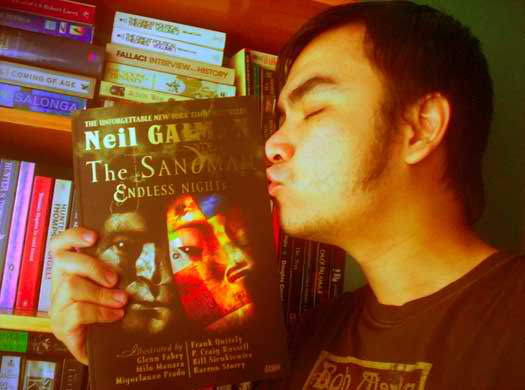
The Sandman: Endless Nights is a follow-up to the Sandman series written by Neil Gaiman. It depends if you want to try the Sandman series you may try reading this first as to get a glimpse or an idea about the whole Sandman story.


*****
In "Endless Nights" Gaiman wrote seven chapters, each devoted to one of the Endless, a family of brothers and sisters ( namely Dream, Death, Desire, Despair, Delirium, Destiny and Destruction ).

It was his way of telling their own story in relations to the different representations of the aspects of life.

Each tale is stylistically written in a different way, and allows Gaiman to work with different talented artists like Milo Manara, Miguelanxo Prado, Glenn Fabry to name a few.

****
"Death and Venice" tells the story of a man's encounter with Death and how he helps her open a door to a world in a different time. This is probably my favorite chapter of the book

"I shall see her again, i know that in my heart, one last time..Until then i shall continue to send people to her"

"What I've Tasted of Desire" is tragic love story of a woman who "wants like a forest fire." The object of her desire is the chieftain's son. They eventually became lovers until a horrible event made the story turn darker. Desire who is neither man or woman is intelligently portrayed through the art renderings of Milo Manara.

"The Heart of a Star" Neil Gaiman takes us to one of the earliest Endless tales, here Dream is seen with one of the very first woman he ever loved. Readers will have a glimpse of the Endless world. While Dream introduces his girl to his other siblings like Desire and Delirum.

"Fifteen Portraits of Despair" isn't really a narrative but a collection of portraits made by Barron Storey, designed by Dave McKean with each image being represented by bits of text that narrates every moments of Despair, like the man who losses his job and continues to pretend to his wife to still have one, a young woman who killed herself and so on, it is as Dark as any one can expect.

"with this pain, i thee feel..."Her kiss is the black dog that follows you in the darkness"

"Going Inside" is a multi facet story that revolves around Delirium, it tells the story of a rescue mission involving a young girl by the most uneven host of characters.

"On the Peninsula" Delirium agrees to help his brother Destruction to dig in an excavation site that they believe lies hidden underneath is the Future.

"Endless Nights" doesn't tells a story because as how it goes only Destiny knows our stories and so on and on. And everything is written in a book he carries all the time. The Artwork by Frank Quitely in this chapter is by far the best among the rest in this book, that is if you will ask me.

*****

This is a must read for Sandman fans, and helps first time readers a wonderful start for those who would like to try out Neil Gaiman's graphic work but were doubting about collecting the ten-book series.

Read More »

Fear and Loathing in Las Vegas - Hunter S. Thompson

0 comments
Hunter S. Thompson's groundbreaking novel about his real life experience traveling to Las Vegas under a pseudonym Raoul Duke and his attorney Dr. Gonzo ( Mexican lawyer and activist Oscar Zeta Acosta in real life).

Tasked by Sports Illustrated to cover the annual Mint 400 race that's going to be held in Las Vegas, after haphazardly planning the trip both Duke and Dr. Gonzo ended up with what Hunter S. Thompson describes as:


"The sporting editors had also given me $300 in cash, most of which was already spent on extremely dangerous drugs. The trunk of the car looked like a mobile police narcotics lab. We had two bags of grass, 75 pellets of mescaline, five sheets of high-powered blotter acid, a saltshaker half-full of cocaine, and a whole galaxy of multi-colored uppers, downers, screamers, laughers . . . and also a quart of tequila, a quart of rum, a case of Budweiser, a pint of raw ether and two dozen amyls"

What was supposed to be an easy sporting coverage of the Mint 400 race quickly turned into an frenzied LSD driven "savage journey to the Heart of the American Dream" and what transpired next is a mixture of mayhem, more drug addiction, hallucinations, booze and pissing every god damn people along the way. Which includes running off from an expensive hotel bill, ditching the Great Red Shark and Lucy the under age girl, and a side job covering the National Narcotics Convention as HST reasons out "the drug people should be rightfully represented".

A classic type of "Gonzo Journalism" that HST have famously invented and practiced throughout his whole writing career. "Fear and Loathing" although lacking in real reportage of journalistic norms or a clear plot, nobody can deny the fact that this book offers some of the best narrative writings only a great writer such as Hunter S Thompson could ever deliver.

From the opening line of

"We were somewhere around Barstow on the edge of the desert when the drugs began to take hold. I remember saying something like, "I feel a bit lightheaded; maybe you should drive . . ."And suddenly there was a terrible roar all around us and the sky was full of what looked like huge bats, all swooping and screeching and diving around the car, which was going about 100 miles an hour with the top down to Las Vegas. And a voice was screaming: "Holy Jesus! What are these goddamn animals?"

to the classic "wave speech" that is for everybody to read out loud and for me belongs in the same league as thet "mad people" quote by Jack Kerouac.

“San Francisco in the middle sixties was a very special time and place to be a part of. Maybe it meant something. Maybe not, in the long run . . . but no explanation, no mix of words or music or memories can touch that sense of knowing that you were there and alive in that corner of time and the world. Whatever it meant. . . . History is hard to know, because of all the hired bullshit, but even without being sure of "history" it seems entirely reasonable to think that every now and then the energy of a whole generation comes to a head in a long fine flash, for reasons that nobody really understands at the time — and which never explain, in retrospect, what actually happened. My central memory of that time seems to hang on one or five or maybe forty nights — or very early mornings — when I left the Fillmore half-crazy and, instead of going home, aimed the big 650 Lightning across the Bay Bridge at a hundred miles an hour wearing L. L. Bean shorts and a Butte sheepherder's jacket . . . booming through the Treasure Island tunnel at the lights of Oakland and Berkeley and Richmond, not quite sure which turn-off to take when I got to the other end (always stalling at the toll-gate, too twisted to find neutral while I fumbled for change) . . . but being absolutely certain that no matter which way I went I would come to a place where people were just as high and wild as I was: No doubt at all about that. . . . There was madness in any direction, at any hour. If not across the Bay, then up the Golden Gate or down 101 to Los Altos or La Honda. . . . You could strike sparks anywhere. There was a fantastic universal sense that whatever we were doing was right, that we were winning. . . . And that, I think, was the handle — that sense of inevitable victory over the forces of Old and Evil. Not in any mean or military sense; we didn’t need that. Our energy would simply prevail. There was no point in fighting — on our side or theirs. We had all the momentum; we were riding the crest of a high and beautiful wave. . . . So now, less than five years later, you can go up on a steep hill in Las Vegas and look West, and with the right kind of eyes you can almost see the high-water mark — that place where the wave finally broke and rolled back.”


If those passages does not amaze you then you don't know how to recognize great writing...and for that you need a reality check....

"Fear and Loating in Las Vegas" its more than being the "best book about the dope decade" its a book where words and prose forms this energy high and dry that will catapult one's imagination LSD or non-LSD into a frenzied acid trip, back to reality and make you crave for such wonderful prose that no other writer living in the world today are capable of writing.

Read More »

Fragile Things - Neil Gaiman

0 comments
Reading a short story collections is like walking through a rain drenched street. You'll never know if its going to be a worthwhile experience or if you wish the sun is up and everything is dry around you.

Same goes with "Fragile Things" it has its wonderful moments and some stories that you wished Neil Gaiman should have just kept in his much talked about attic.


But, Good news is, In this latest short story collections from Neil Gaiman, it is obvious that the good to great short stories outnumbered the bad ones.

From the spine tingling "Feeders and Eaters" which will send scares to any reader, just the thought of having an elderly woman as a next door neighbor eating raw meat and cats is frightening enough and also wonderfully written by Gaiman in this story he said came from an old dream.

In a parallel world setting of a slightly changed streets of London, the world of Sherlock Holmes becomes the opposite of what it was in the "Study of Emerald", and a fitting homage to Sir Arthur Conan Doyle's masterpiece character creation of a great detective solving a crime. It's the first story of the book and mainly sets the bar of expectations of readers for the following stories.

My personal favorite i should say is "Harlequin Valentine" a twisted romantic tale that is recommended for multiple readings, written with such magical prose and character development.

"Monarch of the Glen" a novella which serves as a sequel to "American Gods" here you'll find Shadow two years after the events in "Gods" getting involved with another interesting Gaiman character creations "Mr. Smith" and "Mr. Alice".

In "Keepsakes and Treasures" the narrator details in cold blooded admission his growing up years and his experience hunting down four individuals who may have been his father and how he killed them in the process, the narrator which later turned out to be Mr Smith and how he became the right hand man of Mr. Alice.

The "Sunbird" is also one of my favorite, it tells the story of a club known as the Epicurean Club who shared the same passion of tasting and cooking every known specie on the planet until they realized they haven't tasted a bird called Sunbird which can only be found in Suntown in Cairo, Egypt..but what they found out was a reason why nobody has to eat the Sunbird ever.

"How to talk to Girls at The Parties" involves two coming of age men looking for a party they were invited to, only to end up in the wrong party inhabited by strange but human looking creatures from a totally different world.

"Goliath" inspired by the movie "The Matrix" tells the story of a man tasked to save the world, the real world i mean, not the dream world that he was used to. The last part although saddening shows him living the life he wanted, with a family, home, job only it was only in the dream world as in the real world he was just living the last 20 minutes of his life in a floating spacecraft drifting further into space.

"Closing Time" narrates an effective but mysterious and strange ghost story.

Other notable short stories includes "Bitter Grounds" "Other People" "October in the Chair", an unsolved disappearance in "The Facts in the case of the Departure of Miss Finch".

While the rest, don't worry its just a few, about 4-5 stories and 4 other short poems are just average. With "Diseasemaker's Croup" being the worst inclusion in this otherwise great short story collection.

Read More »

Sandman: Doll's House - Neil Gaiman

0 comments
Volume 2 of the Sandman series. ( it includes issues #9-16 ).

I enjoy Preludes & Nocturnes and i find The Doll's House as notching it up higher in terms of great storytelling and visual feast.

The Doll's House follows a girl named Rose Walker who later learned the real identity of her grandmother, Unity Kincaid ( the hapless girl who spent a great majority of her life in a deep slumber in Preludes & Nocturnes ).


And later on trying to find her long lost brother Jed, at the same time Rose is being monitored by Morpheus aka Dream with her possibly being the "Vortex" that threatens the world and the dreamworld as well.

Hatched through the story are fantastic single-chapter sub plots and short stories that take us away from the action but also help refine the Sandman as character from long way back. The story telling is executed perfectly; never dragging and always perfectly paced.

I particularly like the totally unrelated story ( but it could be in the upcoming volumes ) "Men of Good Fortune", about Hob Gadling, a 14th century man who tried and succeeded in defying death, saying that "It's a mug's game. I wont have any part on it" ( referring to death ).

He then attained immortality. And from his initial conversation with Dream they agreed to meet at the same place once in every hundred years, eventually they both became friends.

But nothing will beat the great storytelling, horror and humor of "Collectors".

In this chapter, Rose Walker and Gilbert find themselves among a Cereal Convention but in reality was a "Serial Killer Convention, where lifelong criminals ( grass widow, psycho killer, candyman, nimrod, dark angel etc ) are gathered and engages in panel discussions in topics like "We are what we are", "Women in Serial Killing" "There is no sanity clause".

It's a humor laden chapter and a harrowing one as well.

The Corinthian: "the good doctor likes to skin people, Nimrod is a bone hunter. He can bone joint and gut any animal in minutes. For myself i have a penchant for eyes. And you know what we're going to do now, Philip?...We're going to take turns"

Not to mention Gilbert's retelling of a supposed to be original version of "Little Red Riding Hood".

*****
Over-all as i said, it keeps getting better. My sandman experience is turning out to be a great one, calls for more urgent needs to get my hand on the following volumes.

The artwork is outstanding, a "Visual Feast" as Bunnylette would say and i agree.

As one online review would say

"This is arguably one of the highlights of the Sandman series and sets the standard for what follows. The Doll's House seems to expand and improve with every reading and should take pride of place on the bookshelf of anyone who likes a good yarn, comic reader or not"

Read More »

Good Omens - Neil Gaiman & Terry Pratchett

0 comments
Good Omens is a fantasy tale written in collaboration between Terry Pratchett and Neil Gaiman about the coming Armageddon or the end of the world. This is my first Terry Pratchett book and one of the many of Neil Gaiman's work. As Terry Pratchett told in an interview about 60% of the idea and the book itself was written by him, with Gaiman contributing through hours of phone conversation.

*****
 

The book centers around an angel Aziraphale and a demon Crowley ( probably the most lovable Demon ), as they try to avert the incoming End of the World as we know it.

Playing a large role in the incoming end of the world is the so called "Anti-Christ" or the Son of Satan.

Despite being on the opposite side of the spectrum, one representing Good, the other one Evil, Aziraphale and Crowley decided to join forces and work together to track down the Son of Satan.

But after a mistake in the switch-up at birth, the perceived Anti-Christ was in fact a normal 11 year old boy, while the real Anti-Christ grows up unsupervised by the followers of hell, in the person of Adam.

Adam is the 11 year old decided leader of a group of kids who called themselves as "Them". Unconscious of his powers he unknowingly sets of a chain of events that eventually started the incoming Apocalypse ( rise of the Atlantis, typhoons, and the 4 horsemen of the Apocalypse ).

When Aziraphale discovered the real identity of the Anti-Christ with the help of the book "the Nice and Accurate Prophecies of Agnes Nutter" He and Crowley then gather themselves together in a race against time to try and avert the End of Days. That is amidst all witch hunters, other Duke of Hells who want to make sure that the Final war between Heaven and Hell takes place on Earth pronto!.

*****

If this is the end of the world, then what a way to go, laughing our asses off. Pratchett and Gaiman succeeded in creating a funny, not so serious yet with serious implications kind of story.

The novel is complete with equally hilarious footnotes ( i suggest you read all of it ), sympathetic characters who in their own way endear themselves to readers alike.

Reading it, i had nothing but love to all characters even Ligur and Hastur makes a fun duo as the Duke of Hell who are after Crowley.

****
Good Omens is a book about good and evil, and the order of things. But most of all, it is a book written by authors who clearly know all the weird and wacky things in the world and most importantly knows how to write them and put it all together in one great novel.

Read More »

The Dharma Bums - Jack Kerouac

0 comments
Jack Kerouac's "The Dharma Bums" is a semi-fictional novel that has since become the trademark of Kerouac's work. In here the narrator Ray Smith ( based on Kerouac ), a poet and self described "Dharma Bum"  a person who searches for the Meaning of Life by following the Buddhist Way) details a period in his life as he hitchhike across the vast frontier of the West unto San Francisco, where he meets a handful of colorful characters where one stands out in the form of Japhy Ryder (said to be poet, essayist and Buddhist Gary Snyder in real life).
 
 
It was the best of times as Ray Smith hangs out with his friend Japhy and other poets in San Francisco getting drunk, going to poetry readings on evenings and generally having a wild Bohemian time the Dharma way.

The best part of the novel comes when Ray Smith narrates their trip to the High Sierras to climb the Matterhorn. A seemingly simple experience but was given life by Kerouac's "Spontaneous Prose" which has influenced writers from the following generations like Hunter S. Thompson, Tom Robbins and even Bob Dylan.

Finding and knowing his spiritual side seems to hold Ray Smith with utmost importance as it parallels these events to the real life Kerouac whose life took a turn to celebrity status after the publishing of his "Legend Turning" work "On The Road".

Driven by the eccentricity of Japhy Ryder whose allure to the simple life and Zen Buddhism greatly affects those around him, thus savoring a simple meal around a small campfire is an experience much greater than dining in an expensive restaurant, they went on buying clothes in run down used clothing store, carrying rucksacks and spending the night in the woods on sleeping bags. Living life the mountaineer way. Being introduced to the Buddhist sexual rite called "Yab-Yum" .

I know today's generation would credit modern writers like Alex Garland with his work on "The Beach" as something of rekindling the "Backpacking" culture. But truth was, Jack Kerouac has been advocating that lifestyle years and years ahead of his time.

Kerouac though his Ray Smith character as he sets out yet another trip across America to visit his mother, spending 3 months meditating and living almost entirely in a garden and going back to San Francisco as he reunites with the rest of the Dharma Bums including Japhy Ryder who in turn is preparing to make his life defining voyage to a monastery in Japan.

The book ends as Ray Smith spends the summer as a fire look-out in the mountains and enjoys the solitary life. ( Jack Kerouac did served as a fire lookout for the United States Forest Service on Desolation Peak in Washington state. )

Semi-Autobiography?, part fiction? nevertheless it's a wonder how a Kerouac book can make me appreciate life as if it was served in a gold platter. You wonder how much else is out there at the tip of your mind just waiting to be discovered.

Wherein "On The Road" painted us a picture of life literally on the road and the somehow captivating experiences we meet upon a reckless yet determined journey, "The Dharma Bums" offers us in insight on the "beat generation's" romance with the Buddhist influence in searching and building an enlightenment for that inner you, in your inner life. Solitary or accompanied by others, simple or grandeur, poor or rich, 5 star accommodation or a rucksack and a sleeping bag in the cold smoldering piece of lot in the wilds. It doesn't matter as long as you embrace life as it was, as it come to you and appreciate it like "spontaneous prose" telling you a great story.

Read More »

The Light Fantastic - Terry Pratchett

0 comments
The Light Fantastic is the 2nd book of the Discworld series by Terry Pratchett. It's a fantasy tale set in a world consisting of a slightly convex disc atop on the backs of four huge elephants which are in turn standing on the back of an enormous turtle, named Great A'Tuin.


The novel starts where the very first Discworld book "Colour Of Magic" ended, with bumbling wizard Rincewind and the Discworld's first ever tourist Twoflower setting adrift, falling over the edge of the world.

But as the wizards in the Unseen University found out about an impending doom that will cause by the Great A'Tuin walking towards a collosal star, which will set the whole Discworld on fire, the only remaining solution to the end of Discworld lies on one of the so called "eight most powerful spells from the octavo" which turns out to be locked inside the head of Rincewind.

With the help of the magic book, Octavo, Rincewind and Twoflower were saved and found themselves back in Discworld, amid talking trees and giant rocks and being tracked by other wizards led by Rincewind's former classmate Trymon.

They encountered countless close brushes with death (whom Rincewind met face to face in Death's domain) Rincewind, Twoflower with the help of aging superhero Cohen The Barbarian, and the girl they saved from a sacrificial ritual named Bethan and Twoflower's luggage who has a mind of its own described as "half suitcase, half homicidal maniac" and was able to save the duo  in a few occasions.

They all set out for a wonderful and entertaining adventure that only Terry Pratchett and a few writers can provide and as the Great A Tuin gets closer to the burning star, triggering panics by the inhabitants of the Discworld who thinks that the only solution would be for all wizards to die and have their spells and magic completely dissappear.

Rincewind will need to remember the spell and say aloud the great eight spell in order to save the Discworld from a head on collision with the burning star..

It's a short and entertaining read, with lots of Terry Pratchett's trademark humor and lovable characters. It's a must read for everybody.

Read More »

Dance, Dance, Dance - Haruki Murakami

0 comments
Haruki Murakami's "Dance Dance Dance" (my very first Murakami book, per recommendation by my officemate Fae ). Follows the story of a 34 year old unnamed narrator, who spends his time working as a freelance writer, abandoned by his wife who runs off with his friend (ouch that fucking hurts), after battling depression in the past, but by now able to function normally in society in his own words by "shoveling snow" (a term that he describes those who goes on with their own roles in society).


Until a recurring dream compelled him to return to Dolphin Hotel, a seedy and strange establishment in a city called Sapporo. The very same place he shared with a woman named "Kiki" who mysteriously disappeared without a trace 4 years ago.

Upon arriving in Sapporo, the narrator finds out that The Dolphin Hotel has been transformed into a modern and five star hotel, gone are the old seedy image of the said hotel.

He learns that it has been has been purchased by a large corporation and converted into a hip, trendy and a style that resembles the great hotels of the west.

But still no answer to the whereabouts of Kiki.

Here our narrator or protagonists meets a wide array of interesting characters, from the serious, uptight female hotel receptionist who shares a mysterious experience with him, an eccentric famous photographer and her 13 year old daughter with psychic abilities who spends her time listening to 80's era bands like the Talking Heads, a one armed poet, a former classmate now an actor typecast as teacher and dentist in the movies.

And then the strange metaphysical experiences starts to unravel as the narrator finds himself in dark corridors, talking to a man called as the "sheep man", and as people he got in contact with either gets murdered or met an accident, he tries hard to come in terms with the mystery of the sheep man and his dreams and what message Kiki is trying to tell him.

In the process Murakami tells a story of a bond forming with a narrator busy with studying the complexities around him and a seemingly uninterested and aloof but smart 13 year old girl, put in a friendship with the former classmate turned matinee idol, and a budding romantic relationship with the sympathetic hotel receptionist.

Whether he finds what he's looking for, in the person of KiKi or some other life realizations, like whether all of them are connected in one way or the other, this book will keep readers interested to the very end.

*****

One will not find it hard to relate to the narrator, i know i did. Because here, the narrator deals with past alienation, his role in society ( whenever he was ask about his profession he always adds the term "shoveling snow" ) doing your own role without abandonment and also a serious tone to it, there were descriptions of what capitalism can do to a country, the effect of having a Masseratti instead of a simple Subaru in telling a person's level of success to society as a whole.

The absurdity that somehow frolics around human relationship with each other, what do we really need in life? a topic that usually comes up with his conversations with his actor friend. The importance of family as he sees the 13 year old girl Yuki's predicament.

All in all this novel is part murder mystery, "metaphysical" tale ( reminds me of Martin Amis' "Other People" ) and throw in a sci-fi edge courtesy of the sheep man.

Wow is all i can say, Haruki Murami, i bet i will be buying more of your books soon.

Read More »

Crash - J.G. Ballard

0 comments
J.G. Ballard's highly controversial novel: famously one publisher's reader returned the verdict "This author is beyond psychiatric help. Do Not Publish."

****
Well if i have read this book, let's say 5 years ago before i would be accustomed to reading the likes of Chuck Palahniuk, Alex Garland, Irvine Welsh and indulging in the brutal humor of Hunter S. Thompson i would probably come into the same conclusion that J.G. Ballard needs professional help.


But knowing what i know now ( haha ), i see J.G. Ballard's "Crash" as a unique work of fiction, powerful and brutal in a way it challenges our imagination by writing about what he calls "an extreme metaphor for an extreme situation, a kit of desperate measures only for use in extreme crisis"

And that metaphor is technology by way of automobiles, wrecked cars and car crashes serving as the "hellish tableau" in which the book's protagonist Vaughan a mad "TV scientist" experiments the relationship between a seemingly traumatic car accident experience and the forming of erotic atrocities with survivors amidst the lifelong remainder of body scar and injuries inflicted by the violent ordeal.

The Narrator which is named after the author, James Ballard relates his initial experience surviving a near fatal car accident which took the life of another person and left him in hospital for weeks, with countless scars on his body.

After being followed by Vaughan, Ballard develops a fetish for erotic experience in the confines of automobiles, developing a sexual relationship with other car crash survivors including the wife of the person he killed in his own automobile accident, Dr. Helen Remington.

As he gets to know the renegade scientist Vaughan, Ballard founds out more strange intricacies in the weird mind of Vaughan, which includes the grand design of his own death involving a terrifying "union of blood...engine coolant in a head on collision with actress Elizabeth Taylor" ( during which time this book is written circa 1973, is still a very popular Hollywood actress )

As Vaughan prepares for his own judgment day, he and Ballard participates with other willing subjects in more erotic experiments involving car accidents more sinister than the last, the end result is a mixture of blood, gore and acid trip and a surprise ending for Ballard.

****

" Vaughan unfolded for me all his obsessions with the mysterious eroticism of wounds: the perverse logic of blood soaked instrument panels, seat-belts smeared with excrement, sun visors lined with brain tissue...He dreamed of ambassadorial limousines crashing into jack knifing butane tankers, of taxis filled celebrating children colliding head-on below the bright display of windows of deserted supermarkets"....

If these passages doesn't make you cringe, then maybe you can read and enjoy this book.

Read More »

Half Asleep in Frog Pajamas - Tom Robbins

0 comments
This is my first Tom Robbins' novel, fellow multiplier Karl and Aimee has been recommending him forever. I now know why.


"Half Asleep in Frog Pajamas" as the title would suggest is filled with humor and hilarious situations and most of all extra terrestrials without becoming a science fiction novel.

The heroine, Filipina stockbroker Gwen Mati ( her father being a Filipino, mother an Irish ) thought she just had the worst day of her young career, as stocks crashed and she tries to cover her ass while awaiting the resumption of the trading over the course of a long weekend she encounters strange happenings around her.

First, her boyfriend's jewel stealing monkey but presumed to be a born again monkey went missing, offering her help in trying to locate the damned monkey her bestfriend Q-Jo a 300 pound psychic went missing too after meeting with a fellow who later turned out to be Larry Diamond, a former stockbroker turned financial renegade who just spent a long time of soul searching or should i say searching for the origin of mankind in a far away place called as Timbuktu.

Over the course of the next few days, Gwen Mati will jerk around from one revelation to another (most seemingly crazy) brought on by the eccentric Larry Diamond ranging from the origins of frogs, mysterious African rituals to outer space sexuality.


There isn't much of an in depth character study that most novels had, some will prove great while others tend to bore you. I think it's Tom Robbins' style to write stories like this, with plots twisting and turning until it becomes a real mystery with killer lines and quotes that will make one ran out of highlighter ink.

For the more serious readers who lack a sense of humor they might find Tom Robbins a disappointment, but knowing what i know now, why most of his books have weird titles and the plot are outrageous to say the least, well at least it gives me joy and enriches my imagination with the things he writes and most of the times he writes it real good.

As for me, there are still two Tom Robbins book waiting on my shelf to be read and I'm sure hell looking forward to reading those books and scoring more Tom Robbins novels...

Read More »

Diary - Chuck Palahniuk

0 comments
Love him or hate him, i'm talking about Chuck Palahniuk.

In my case, i have nothing but love for his work.

Probably America's most nihilistic writer, Chuck Palahniuk once again has tip toed in the world of madness, the grotesque, human sufferings all that plus salt sprayed with endless dark humor.


As one critic would put it "If you're looking for comparisons, I'd say Palahniuk is like a cross between Tim Powers on acid and Kurt Vonnegut gone postal."

Diary takes form as a journal written by Misty Wilmot, a former art student with a once promising future but now reduced to waiting tables at a seafront hotel in an island called Waytansea.

To rub salt to the wound, her husband Peter is in a state of a coma after a seemingly failed suicide attempt. Soon Misty finds herself besieged with phone calls from angry customers, regarding house renovation jobs that Peter did in the past, seems like Peter has a fondness for leaving vile and disturbing messages painted on each of the houses' walls and plastering off whole rooms.

After the intervention of her mother in law, Grace. Misty, in a sudden burst of creativity goes back to painting. After finishing about a hundred paintings, believing her daughter Tabbi is dead, befriending a "handwriting expert", a cop assigned to the nations 'hate crime division' showing up to ask some questions, harboring a connection to painters from the past Maura Kincaid and Constance Baron, Carl Jung theories, Jain Buddhists and a conspiracy that threatens the lives of hundreds, Misty's world is rapidly turned into one frenetic chase for sanity amidst all cynical and unusual twists that only Chuck Palahniuk can deliver.

*****
Most critics take against Chuck Palahniuk was that all of his characters are almost the same, shocking, mad, anger prone, a walking "fuck you" sign all that plus his sick humor.

Which i don't get, why take it against the man whose style is synonymous to spookily imaginative and superbly grim, well in this case in Diary, gone are the Tyler Durden charisma, but for the second time since "invisible monster" it takes form at a female point of view, a girly character although not the usual chick on the block.

Misty Wilmot is the closest you'll ever get to the Tyler Durden type bullshit-philosopher character, in "Diary" Chuck Palahniuk laid out an "in your face" narratives with cool repetition phrases such as "Just for the record, the weather today is calm and sunny, but the air is full of bullshit", "bermuda triangulated" when falling short of an explanation.

I can understand the short cuts that Palahniuk makes in his novel, in his own admission he is a minimalist, no need to go into the depths of a scenario, i mean who cares, as long as the character is, as i said before an "in your face" who don't give a fuck about his/her surroundings.

Bottomline: This novel is most of the times hilarious, expectedly disturbing, frightening and poignant at the same time ( thus the association with Douglas Coupland everytime i think Chuck Palahnik ) -- but it's always clever and well-written. Not a book to be missed.

Read More »

The Stranger - Albert Camus

0 comments
The novel in which French Novelist and moralist Albert Camus explored what he termed as "the nakedness of man faced with the absurd".

Meursault ( his surname ), narrates the last part of his life, from the opening line of "Maman died today" ( Maman being a child's term for mother ) , Meursault tells with all honesty the events that followed.


Upon returning to Algiers after burying his mother he crossed paths with an old officemate Marie, whom he develops an intimate relationship, life for him is going to work everyday, being loyal to his firm, waiting for each Saturday to spend the day with Marie, dealing with his neighbors in a friendly manner, Salamano and his dog, restaurant owner Celeste and a self described "warehouse guard" Raymond.

Problem arises when Raymond got in trouble with a group of Arabs.

During a trip to an Algier beach side, Raymond, Masson ( Raymond's friend ) and Meursault got in a fight with the Arabs who followed them, Raymond was cut by a knife in the arm and side of the mouth.

Afterwards for no reason, Meursault went back to the beach, at the same spot where he found the Arab in the sun drenched Algiers Beach, in what he narrates as

"I knew i had shattered the harmony of the day, the exceptional silence of a beach where i'd been happy. Then i fired four more times at the motionless body where the bullets lodged without leaving a trace. And it was like knocking four quick times on the door of unhappiness".

Meursault, an ordinary man now unwittingly gets drawn into a senseless murder.

Meursault then narrates the investigation that follows, the trial and the sentencing all with cunning and honest description of his feelings, the freedom, the life that he lost and the eventual acceptance of his fate.

******
Originally written in French, translated into English countless times, the new English version by Matthew Ward is called as the most truest Camus English rendition ever.

"Mother died today" was aptly replaced by "Maman died today" as one of the example of being true to Camus' version.

Albert Camus is considered as a moralist, a philosopher among being a great novelist, among his works are the non-fiction philosophical essay "the Rebel" and fiction like "the Plague", "the Fall" and "exile in the kingdom" all dealing with Man's inner senses and nature, with the Plague being a parable of Man's moral resonance.

In the Stranger, Camus writes in a fast faced manner, short in details of the surroundings, more cut to the chase with regards to the Narrator's feelings of himself and those who are around him.

"I explained to him, however, that my nature was such physical needs got often in the way of my feelings, the day i buried Maman, i was very tired and sleepy"

In explaining to his lawyer the reason for his seemingly "insensitivity" during his mother's funeral.

It was a book that lets readers an inside spot in the mind of a person as Camus stated "faced with the absurd", dealing with his actions, getting use to life with no freedom and eventually accepting the fate that awaits him.

"When i was first imprisoned, the hardest thing was that my thoughts were still those of a free man, for example i would suddenly have the urge to be on a beach and to walk down to the water...all of a sudden i would feel just how closed in i was by the walls of my cell...but those lasted a few months...afterwards my only thoughts were those of a prisoner"

****
It was a short read like a long essay, 123 pages in all, it will just take up an hour of your life, but i tell you its one hour you would never ever regret losing.

Read More »

Sandman: Dream Country - Neil Gaiman

0 comments
The shortest so far from the 5 other Sandman volumes that i've read. This volume is a collection of four stand alone stories that explains some aspects about the Endless namely Dream and Death. Although not a continuation of the Sandman storyline, still it offers readers a lot in regards to the over all scope of this monumental Sandman series.


Calliope - a short story about a struggling one hit writer Ric Madoc and his obsession to reach top form again, doing so he receives a present from cult filmmaker Erasmus Fry, in the form of a muse, whom he abuses and rapes after drawing inspiration from her and writing bestsellers, directing movies and unto the peak of success. Until Dream, who is the muse's former flame, escapes from his captor and decided to free up his muse and gives Madoc a lesson or two about not having any ideas at all.

A Dream of a Thousand Cats - an imaginative tale that shows a gathering of cats and their dream of a world where cats are the masters and human as its servants, a frightening possibility that one feline speaks of, if only all the cats in the world will believe that it is the case ever since the beginning of time.

A Midsummer Night's Dream - won the World Fantasy award for best short story, tells the story of William Shakespeare and his wandering theater troupe and it's performance in front of an audience that looks like not any audiences they have played for in the past.

Facade - is a short story related to another Sandman volume, the Kindly Ones. Former superhero known as the Fury, Lyta Hall now lives in almost seclusion. In the end with the help of "Death" her powers becomes the solution to how she will be freed.

Although i really want to read this volume because i was so curious about Midsummer Night's Dream, although it turned out quite well, i can say my favorite is "Dream a Thousand Cats", the artwork is creepy, the theme so dark and the message frighteningly chilling.

While Calliope reminds me of people who would sell their soul, in exchange for a burst of creativity, makes me wonder who among us right now has a muse somewhere hidden in their bedroom whom they keep imprisoned and abused. Yes another creepy tale.

Plus the inclusion of the sample script by Neil Gaiman will teach you a thing or two about how to write and imagine a story that is ought to be written as a comic book.

All the more makes this a must read for everybody.

Read More »