Satori in Paris - Jack Kerouac

2 comments
Satori in Paris was a short autobiographical book (about a bit over 100 pages) by Jack Kerouac in which he describes as about:

"Somewhere during my ten days in Paris (and Brittany) I received an illumination of some kind that seems to've changed me again, towards what I suppose'll be my pattern for another seven years or more: in effect, a satori: the Japanese word for 'sudden illumination,' 'sudden awakening' or simply 'kick in the eye."


Wherein in "On the Road" Kerouac's brave novel about a cross country trip across the Continental USA he wrote about two characters on search of meaning and friendship stretched across thousands of miles, in Satori, Kerouac dishes out a remarkable narrative of his brief 10 days stay in Paris in his quest to trace his family name's geneology.

The usual drunken spree present in earlier Kerouac novels are almighty present in this book, seems like our favorite writer gets the drive of writing his "spontaneous prose" amid massive hangover. Which to my endeavor i find to be an attractive style of writing and narrative.

In each Kerouac book that i've read, always there's a favorite quote that stands out. In this book i've highlighted this passage:

"My manners, abominable at times, can be sweet. As I grew older I became a drunk. Why? Because I like ecstasy of the mind.  I'm a Wretch. But I love love"

 The romantic side of Kerouac, devious as it may seem infects individuals like me to live such a life amid a grotesque setting and mundane existence but with forever awe at his surroundings, people around him, embracing other's attention in such setting as a semi deserted park, singing or just downing beers and whiskey in pubs.

In Satori, a book Kerouac wrote at the twilight of his life, gone are the reckless years of the era of "On the Road" but effective still in terms of profoundness in how he described a mere 10 day stay in a place where he thinks his name originated.

Did he accomplished his goal in the end? more than what he ever planned in the first place. In the end Kerouac accomplished a "Satori" an illumination, that ironically he never got to display or live through "
for another seven years or more" as Kerouac would die early in 1969.


Read More »

Batman: The Killing Joke - Alan Moore

0 comments
They say this comic book was the driving force behind Heath Ledger's brutal portrayal of Joker in the movie "The Dark Knight". It might be the case, because Joker, in this book was at his most brutal ever. Alan Moore left no inhibitions at how violent and mad Joker can be.


Which includes Joker shooting Commissioner Gordon's daughter in the spine, showing no remorse in mentally torturing Gordon, trying hard to make him crumble into madness as he oftentimes says that the only difference between a sane man and a psychotic criminal was "one bad day".

"one bad day" might have caused Joker's slide into the dark side as the story interchange with flashbacks of Joker's old life which may give hints of his possible origin. But no one can be certain as Joker says "Sometimes I remember it one way, sometimes another... If I'm going to have a past, I prefer it to be multiple choice!"

Alan Moore, presented a possible origin of Joker when he was still a normal human being and this creates a Joker presented in both extreme personalities, which makes "The Killing Joke" a rarity in terms of storytelling.

And did i hear someone mention something about Borland's art in this book?

The facial expression of each characters really gives life to the story, the shadows, the colors, the minimal colors during the flashback scenes all makes up for an eye feast at the same time.

The colors was lurid and brimming with intelligent eye for details. Borland and Moore really concocted a very creative partnership in this graphic novel.

From start to Joker's last joke at the end, it was a short read (bitin konti) but a really great read. Something you can't help but read over and over again.

Read More »

Watchmen - Alan Moore

0 comments
Let me start this review by quoting Harlan Ellison "anyone who misses this milestone event in the genre of the fantastic is a myopic dope."

I'm glad that after reading Alan Moore's "Watchmen" i am not a myopic dope anymore. For some they ask the question "Why comic books should grow this far?"


My answer is why not, comic books or graphic novels whatever you may want to call it still serve its purpose as another reading option whether it tells simple, fanatical stories or complex, dark and haunting story line with troubled characters and the impending doom of the world plots, i say it's even better thanks to Alan Moore's groundbreaking "Watchmen".

Watchmen is set in the year 1985 of a distinctly altered history with Richard Nixon still the US President, America winning the Vietnam War. 8 years before that costumed superhero or vigilantes were outlawed by the Keene Act. Before that, outlawed superheroes were an ordinary part of society, grabbing headlines with their anti crime crusade until pressures from other law enforcement agencies forced some lawmakers passing a law regulating vigilantes.

Watchmen is part political thriller, part murder mystery when the opening panels shows a murdered former costumed vigilante named "the Comedian". An investigation to the cause of his death was closely followed by another costumed vigilante named "Rorschach".

After a mysterious conspiracy that drove the only remaining but regulated adventurer Dr. Manhattan out of Earth and into Mars, a series of conflicts arises beginning with the Russian invasion of Afghanistan and the looming threat of a nuclear war closes in, the remaining costumed vigilante like Rorschach, the Nite Owl II unites and decides to get into the bottom of things and try to uncover the identity of the individual behind the whole conspiracy starting with the murder of the Comedian, the character assassination on Dr. Manhattan and mysterious threat to the life of the other Superheroes.

The flow of the story is very entertaining with brilliant lines and magnificent artworks which is done by renowned artist Dave Gibbons.

Another interesting concept that the Watchmen offers is the "Black Freighter" , a comic book written within the Watchmen world, a so called "post modern metafiction" that also annotates and represents some of the ideas for the main plot.

The book has an abundance of themes, mainly it expresses the notion of questioning the main perception of authority. As there are Watchmen that watches over us, fights crime and all, but the question lingers as to "who will watch the watchmen", this is definitely the one thing each reader may ask themselves once they got into the surprising conclusion in the end.

The possibility of the Apocalypse and other conspiracy theories also forms a part of the plot.

Over-all this comic book, deserves to be at the top of your reading list, if you still haven't read this one.

*****
A "Watchmen" movie is currently in the works with "300" director Zach Snyder working behind the lens...can't wait for it, tentatively scheduled for release on May 2009....yes that's a year and a half from now.

Read More »

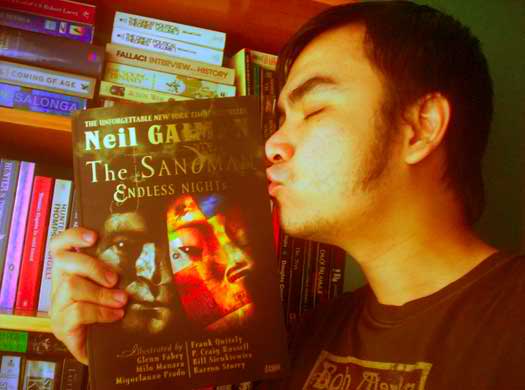
Sandman: Endless Nights - Neil Gaiman

1 comments
The Sandman: Endless Nights is a follow-up to the Sandman series written by Neil Gaiman. It depends if you want to try the Sandman series you may try reading this first as to get a glimpse or an idea about the whole Sandman story.


*****
In "Endless Nights" Gaiman wrote seven chapters, each devoted to one of the Endless, a family of brothers and sisters ( namely Dream, Death, Desire, Despair, Delirium, Destiny and Destruction ).

It was his way of telling their own story in relations to the different representations of the aspects of life.

Each tale is stylistically written in a different way, and allows Gaiman to work with different talented artists like Milo Manara, Miguelanxo Prado, Glenn Fabry to name a few.

****
"Death and Venice" tells the story of a man's encounter with Death and how he helps her open a door to a world in a different time. This is probably my favorite chapter of the book

"I shall see her again, i know that in my heart, one last time..Until then i shall continue to send people to her"

"What I've Tasted of Desire" is tragic love story of a woman who "wants like a forest fire." The object of her desire is the chieftain's son. They eventually became lovers until a horrible event made the story turn darker. Desire who is neither man or woman is intelligently portrayed through the art renderings of Milo Manara.

"The Heart of a Star" Neil Gaiman takes us to one of the earliest Endless tales, here Dream is seen with one of the very first woman he ever loved. Readers will have a glimpse of the Endless world. While Dream introduces his girl to his other siblings like Desire and Delirum.

"Fifteen Portraits of Despair" isn't really a narrative but a collection of portraits made by Barron Storey, designed by Dave McKean with each image being represented by bits of text that narrates every moments of Despair, like the man who losses his job and continues to pretend to his wife to still have one, a young woman who killed herself and so on, it is as Dark as any one can expect.

"with this pain, i thee feel..."Her kiss is the black dog that follows you in the darkness"

"Going Inside" is a multi facet story that revolves around Delirium, it tells the story of a rescue mission involving a young girl by the most uneven host of characters.

"On the Peninsula" Delirium agrees to help his brother Destruction to dig in an excavation site that they believe lies hidden underneath is the Future.

"Endless Nights" doesn't tells a story because as how it goes only Destiny knows our stories and so on and on. And everything is written in a book he carries all the time. The Artwork by Frank Quitely in this chapter is by far the best among the rest in this book, that is if you will ask me.

*****

This is a must read for Sandman fans, and helps first time readers a wonderful start for those who would like to try out Neil Gaiman's graphic work but were doubting about collecting the ten-book series.

Read More »

Fear and Loathing in Las Vegas - Hunter S. Thompson

0 comments
Hunter S. Thompson's groundbreaking novel about his real life experience traveling to Las Vegas under a pseudonym Raoul Duke and his attorney Dr. Gonzo ( Mexican lawyer and activist Oscar Zeta Acosta in real life).

Tasked by Sports Illustrated to cover the annual Mint 400 race that's going to be held in Las Vegas, after haphazardly planning the trip both Duke and Dr. Gonzo ended up with what Hunter S. Thompson describes as:


"The sporting editors had also given me $300 in cash, most of which was already spent on extremely dangerous drugs. The trunk of the car looked like a mobile police narcotics lab. We had two bags of grass, 75 pellets of mescaline, five sheets of high-powered blotter acid, a saltshaker half-full of cocaine, and a whole galaxy of multi-colored uppers, downers, screamers, laughers . . . and also a quart of tequila, a quart of rum, a case of Budweiser, a pint of raw ether and two dozen amyls"

What was supposed to be an easy sporting coverage of the Mint 400 race quickly turned into an frenzied LSD driven "savage journey to the Heart of the American Dream" and what transpired next is a mixture of mayhem, more drug addiction, hallucinations, booze and pissing every god damn people along the way. Which includes running off from an expensive hotel bill, ditching the Great Red Shark and Lucy the under age girl, and a side job covering the National Narcotics Convention as HST reasons out "the drug people should be rightfully represented".

A classic type of "Gonzo Journalism" that HST have famously invented and practiced throughout his whole writing career. "Fear and Loathing" although lacking in real reportage of journalistic norms or a clear plot, nobody can deny the fact that this book offers some of the best narrative writings only a great writer such as Hunter S Thompson could ever deliver.

From the opening line of

"We were somewhere around Barstow on the edge of the desert when the drugs began to take hold. I remember saying something like, "I feel a bit lightheaded; maybe you should drive . . ."And suddenly there was a terrible roar all around us and the sky was full of what looked like huge bats, all swooping and screeching and diving around the car, which was going about 100 miles an hour with the top down to Las Vegas. And a voice was screaming: "Holy Jesus! What are these goddamn animals?"

to the classic "wave speech" that is for everybody to read out loud and for me belongs in the same league as thet "mad people" quote by Jack Kerouac.

“San Francisco in the middle sixties was a very special time and place to be a part of. Maybe it meant something. Maybe not, in the long run . . . but no explanation, no mix of words or music or memories can touch that sense of knowing that you were there and alive in that corner of time and the world. Whatever it meant. . . . History is hard to know, because of all the hired bullshit, but even without being sure of "history" it seems entirely reasonable to think that every now and then the energy of a whole generation comes to a head in a long fine flash, for reasons that nobody really understands at the time — and which never explain, in retrospect, what actually happened. My central memory of that time seems to hang on one or five or maybe forty nights — or very early mornings — when I left the Fillmore half-crazy and, instead of going home, aimed the big 650 Lightning across the Bay Bridge at a hundred miles an hour wearing L. L. Bean shorts and a Butte sheepherder's jacket . . . booming through the Treasure Island tunnel at the lights of Oakland and Berkeley and Richmond, not quite sure which turn-off to take when I got to the other end (always stalling at the toll-gate, too twisted to find neutral while I fumbled for change) . . . but being absolutely certain that no matter which way I went I would come to a place where people were just as high and wild as I was: No doubt at all about that. . . . There was madness in any direction, at any hour. If not across the Bay, then up the Golden Gate or down 101 to Los Altos or La Honda. . . . You could strike sparks anywhere. There was a fantastic universal sense that whatever we were doing was right, that we were winning. . . . And that, I think, was the handle — that sense of inevitable victory over the forces of Old and Evil. Not in any mean or military sense; we didn’t need that. Our energy would simply prevail. There was no point in fighting — on our side or theirs. We had all the momentum; we were riding the crest of a high and beautiful wave. . . . So now, less than five years later, you can go up on a steep hill in Las Vegas and look West, and with the right kind of eyes you can almost see the high-water mark — that place where the wave finally broke and rolled back.”


If those passages does not amaze you then you don't know how to recognize great writing...and for that you need a reality check....

"Fear and Loating in Las Vegas" its more than being the "best book about the dope decade" its a book where words and prose forms this energy high and dry that will catapult one's imagination LSD or non-LSD into a frenzied acid trip, back to reality and make you crave for such wonderful prose that no other writer living in the world today are capable of writing.

Read More »

Fragile Things - Neil Gaiman

0 comments
Reading a short story collections is like walking through a rain drenched street. You'll never know if its going to be a worthwhile experience or if you wish the sun is up and everything is dry around you.

Same goes with "Fragile Things" it has its wonderful moments and some stories that you wished Neil Gaiman should have just kept in his much talked about attic.


But, Good news is, In this latest short story collections from Neil Gaiman, it is obvious that the good to great short stories outnumbered the bad ones.

From the spine tingling "Feeders and Eaters" which will send scares to any reader, just the thought of having an elderly woman as a next door neighbor eating raw meat and cats is frightening enough and also wonderfully written by Gaiman in this story he said came from an old dream.

In a parallel world setting of a slightly changed streets of London, the world of Sherlock Holmes becomes the opposite of what it was in the "Study of Emerald", and a fitting homage to Sir Arthur Conan Doyle's masterpiece character creation of a great detective solving a crime. It's the first story of the book and mainly sets the bar of expectations of readers for the following stories.

My personal favorite i should say is "Harlequin Valentine" a twisted romantic tale that is recommended for multiple readings, written with such magical prose and character development.

"Monarch of the Glen" a novella which serves as a sequel to "American Gods" here you'll find Shadow two years after the events in "Gods" getting involved with another interesting Gaiman character creations "Mr. Smith" and "Mr. Alice".

In "Keepsakes and Treasures" the narrator details in cold blooded admission his growing up years and his experience hunting down four individuals who may have been his father and how he killed them in the process, the narrator which later turned out to be Mr Smith and how he became the right hand man of Mr. Alice.

The "Sunbird" is also one of my favorite, it tells the story of a club known as the Epicurean Club who shared the same passion of tasting and cooking every known specie on the planet until they realized they haven't tasted a bird called Sunbird which can only be found in Suntown in Cairo, Egypt..but what they found out was a reason why nobody has to eat the Sunbird ever.

"How to talk to Girls at The Parties" involves two coming of age men looking for a party they were invited to, only to end up in the wrong party inhabited by strange but human looking creatures from a totally different world.

"Goliath" inspired by the movie "The Matrix" tells the story of a man tasked to save the world, the real world i mean, not the dream world that he was used to. The last part although saddening shows him living the life he wanted, with a family, home, job only it was only in the dream world as in the real world he was just living the last 20 minutes of his life in a floating spacecraft drifting further into space.

"Closing Time" narrates an effective but mysterious and strange ghost story.

Other notable short stories includes "Bitter Grounds" "Other People" "October in the Chair", an unsolved disappearance in "The Facts in the case of the Departure of Miss Finch".

While the rest, don't worry its just a few, about 4-5 stories and 4 other short poems are just average. With "Diseasemaker's Croup" being the worst inclusion in this otherwise great short story collection.

Read More »

Sandman: Doll's House - Neil Gaiman

0 comments
Volume 2 of the Sandman series. ( it includes issues #9-16 ).

I enjoy Preludes & Nocturnes and i find The Doll's House as notching it up higher in terms of great storytelling and visual feast.

The Doll's House follows a girl named Rose Walker who later learned the real identity of her grandmother, Unity Kincaid ( the hapless girl who spent a great majority of her life in a deep slumber in Preludes & Nocturnes ).


And later on trying to find her long lost brother Jed, at the same time Rose is being monitored by Morpheus aka Dream with her possibly being the "Vortex" that threatens the world and the dreamworld as well.

Hatched through the story are fantastic single-chapter sub plots and short stories that take us away from the action but also help refine the Sandman as character from long way back. The story telling is executed perfectly; never dragging and always perfectly paced.

I particularly like the totally unrelated story ( but it could be in the upcoming volumes ) "Men of Good Fortune", about Hob Gadling, a 14th century man who tried and succeeded in defying death, saying that "It's a mug's game. I wont have any part on it" ( referring to death ).

He then attained immortality. And from his initial conversation with Dream they agreed to meet at the same place once in every hundred years, eventually they both became friends.

But nothing will beat the great storytelling, horror and humor of "Collectors".

In this chapter, Rose Walker and Gilbert find themselves among a Cereal Convention but in reality was a "Serial Killer Convention, where lifelong criminals ( grass widow, psycho killer, candyman, nimrod, dark angel etc ) are gathered and engages in panel discussions in topics like "We are what we are", "Women in Serial Killing" "There is no sanity clause".

It's a humor laden chapter and a harrowing one as well.

The Corinthian: "the good doctor likes to skin people, Nimrod is a bone hunter. He can bone joint and gut any animal in minutes. For myself i have a penchant for eyes. And you know what we're going to do now, Philip?...We're going to take turns"

Not to mention Gilbert's retelling of a supposed to be original version of "Little Red Riding Hood".

*****
Over-all as i said, it keeps getting better. My sandman experience is turning out to be a great one, calls for more urgent needs to get my hand on the following volumes.

The artwork is outstanding, a "Visual Feast" as Bunnylette would say and i agree.

As one online review would say

"This is arguably one of the highlights of the Sandman series and sets the standard for what follows. The Doll's House seems to expand and improve with every reading and should take pride of place on the bookshelf of anyone who likes a good yarn, comic reader or not"

Read More »