One Flew over the Cuckoo's Nest - Ken Kesey

0 comments
It was the Psychedelic 60's and the vast drug experimentation of Americans took on another level, the junkies, the sane and insane alike. For the mentally unstable medication through Psycho therapy became a fad like no other.


Wanting to learn more about this unusual behaviour Ken Kessey volunteered himself to take part in a study at the Menlo Park Veterans Hospital on the effects of psychoactive drugs. His experiences as a medical guinea pig inspired Kesey to write One Flew Over the Cuckoo's Nest in 1962.

********

One Flew Over The Cuckoo's Nest was set in a fictional mental asylum ruled by a "tyranical" middle aged Nurse Ratched. Narrated by the towering Native-American Chief Bromden a schizophrenic who pretends to be both deaf and dumb.

Through his self-imposed solitude Bromden accurately observed each element of the hospital's surroundings and manages to give readers a full and personal account of the arrival of the rebellious new inmate R.P. McMurphy. ( whose initials can be aptly defined as "revolution per minute").

Enter Randle P. McMurphy, a petty criminal who fakes his own madness in order for him to be admitted in the institution and therefore avoid a lenghty prison term.

Prior to the arrival of McMurphy, the asylum was run by the domineering Nurse Ratched and her assistants ( who were described as black men by Bromden ). The patient's life revolves around a clockwork precision setting bound by the strict rules of the staff members.

McMurphy brought with himself a symbol of resistance and rebellious exuberance against these rules, he finds the "therapeutic techniques" of the staff as non-existent, that medicated drug and the threat of electro shock therapy is not making the patients well, but just a method to keep them scared and forever following authority.

And the ensuing results is a never ending battle between McMurphy and Nurse Ratched.

*****

The book represents a much larger aspect other than life in a mental institution, it also paints the over-all battle of the weak and the strong in society as well. The main characters' struggle to regain sanity in the mental institution clearly represented the title "One Flew Over The Cuckoo's Nest" which is Chief Bromden's memory of a children's nursery rhyme that depicts a group of geese flying in different directions, continously opposing each other. In the book it is Nurse Ratched, McMurphy, the Chief, the acutes and the chronics who were literally and symbolically representing the wild geese chase.

Ken Kessey's beliefs that most of the patients he encountered as a volunteer and late r on while working in Menlo Park as a nurse assistant, doesn't really fit the typical crazed man. Only he believes that these people were sent to such place making them to believe that professional help and aid of drugs can help them get back to the system's definition of a sane man.

Wherein Kessey's beliefs that these patients were not insane, that society had pushed them out because they did not fit the conventional ideas and ideal stratosphere of how people were supposed to act and live their life.

And the result was a literary gift that critics hailed as one of the best novels of all time.

*****
I haven't seen the movie version, but its hard not to think of Jack Nicholson when reminded of Randall McMurphy, the zest of his character critics describes as a bit Dean Moriarty of Kerouac's "On the Road", which is understandable to think that Ken Kesey is a part of that so called "beat generation". His other novel "Sometimes a Great Notion" was a product of his experiences with the 'muse' of the beatniks, Neal Cassady who introduced Kesey to the other "beatniks" Kerouac, Ginsberg and Timothy Leary.

Randall McMurphy is the character that is not about to impress or be a leader of the pack, he was just this trickster, a joker, gambler, no good man ( according to the norms of society ). But along the way he became this 'personal saviour' of other patients. ( other scholars refers to him as a Christ like figure whose sacrifices left a valuable lesson to the other patients). In a way a rebel with a cause, out to defy authority that subjects its followers as slave. To quote Harding "the strong becomes strong while continously devouring the weak".

McMurphy is the symbol that gives life to an otherwise normal set-up of the Asylum, where-in Ken Kesey's challenges and questions about the state of psycho therapy in America, of the ruler's rule over its followers, in a sense that it asks the question of tyranny, the urge or fetish of creating an order of rules, authority for the so called greater good but at the moment neglecting the proper and just things that makes a human being alive. In doing so, this so called parameters makes a human soul more stagnant than ever before.

Bounded by paralysis, mental anguish and labels such as Acutes, Chronics and other clinical terms.

And after reading this book, you might as well find yourself asking the very same questions that Kesey brought up in this great novel.

Read More »

Slaughterhouse Five - Kurt Vonnegut

0 comments
Kurt Vonnegut's "Slaughterhouse-Five" said to be his most popular and distinguished work depicts his real life experience as a prisoner of war during World War II in which while imprisoned in the German city of Dresden he saw first hand the retaliatory air raids conducted by the Allied warplanes which up to now remains as one of the few controversial Allied actions of World War II. It is said that the bombing of Dresden killed more people than the atomic bombing of Hiroshima.
 
 
Using the initial plot of the Dresden bombing through the eyes of an American Soldier named Billy Pilgrim ( based on Vonnegut's own experience ), Kurt Vonnegut carefully weaved the story with science fiction elements and time travel as a major plot's driving force as we see Pilgrim get caught in a so called "unstuck in time" where he would revisit different events in his life randomly, like being a prisoner of war in Dresden to a practicing optometry in a fictional town called Illium to his eventual abduction by aliens from the planet Tralfamadore, who exhibit him in a Tralfamadorian zoo with Montana Wildhack, a pornographic movie star.

This is not a conventional novel in terms of storytelling, in case that the Dresden experience of the main character serves only as one of the plot lines but at the same time it stands out among as the main theme of the novel.

The first chapter has Vonnegut as the main narrator, him discussing his passion about writing something about his own experiences in Dresden as a prisoner of war caught in between the fighting Germans who are in their last ditch stand and the growing might of the advancing Russian Forces from Berlin and the carpet bombing insinuated by the Allies towards the end of the war.

Being a humanist Kurt Vonnegut wrote this book not alluding to any side or faults on the outcome that happened in the War like in Dresden. Both sides are guilty of overkill, The Axis started and committed astrocities at a large scale. In this book Vonnegut is just merely telling a story about an event not really known to readers at the time this book was published.

As the novel progresses and Billy Pilgrim shifts from one period of his life to another we encounter colorful characters from Paul Lazzaro, ill-tempered car thief from Cicero, Illinois, Edgar Derby, the oldest among the prisoners, to Kilgore Trout an unsuccessful science-fiction writer who also appears in a number of Vonnegut book.

The descriptions of the Trafalmadorians are of classic Vonnegut humor. Trafalmadorians communicate telepathically through a "sort of electric organ which made Earthling sound".

"Why me?" Billy said.
"Well he we are Mr. Pilgrim, trapped in the amber of this moment. There is no why".

Over-all this book is wonderfully penned by combining fantasy with realism, added with fictionalized memoir, written in a comedic mode as horror is overtaken by a kind of fatalistic yet funny view of life even at the most absurd situations.

Kurt Vonnegut has written a fantasy tale that serves or reminds us the horrors of war, but it's not an anti-war novel because as he says, "there would always be wars, that they were as easy to stop as glaciers...and there would still be plain old death" and "SO IT GOES".

Read More »

On The Road - Jack Kerouac

0 comments
A short time after he and his wife split up, Sal Paradise a young and innocent writer longing for fresh experience, met the eccentric, spontaneous, "slightly crazed" Dean Moriarty on a "breathless, exuberant ride back and forth" life on the road across th highways, from city to city, gas stations, bars, cheap hotels, east west of America.
 

Along the way encountering countless cast of characters ( poet Carlo Marx, Dean's 3 wives, Maryloy, Camille, Inez, Sal's brief romance with a young mexican girl...to a young mexican pimp Victor among others )"Their hedonistic search for release or fulfilment though drinks, sex, drugs and jazz becomes an exploration of personal freedom an their own self.

With a vivid description of life on the road. Jack Kerouac blended fiction and real life ( part of the story was based on his real life experiences as a lonesome traveller ) that many critics called "a novel that defined the new beat generation, its tremendous impact....made him famous overnight"

Acclaimed writer William Burroughs adds "On the Road sold a trillion levis and a million espresso machines, and also sent countless kids on the road..the alienation, the restlessness, the dissatisfaction were already there waiting when Kerouac pointed out the road"

**************

Although this is a tale or an example of the American dream, the message is clear to me, life is meant to be one great adventure, either by staying on one place or continously moving from one place to another, meeting friends and strangers that interest you as Sal Paradise aptly puts it

"because the only people for me are the mad ones, the ones who are mad to live, mad to talk, mad to be saved, desirous of everything at the same time, the ones who never yawn or say a commonplace thing, but burn, burn, burn like fabulous yellow roman candles exploding like spiders across the stars and in the middles you see the centrelight pop and everybody goes AWW" - on the road ( wow what a powerful paragraph, i like that "burn, burn, burn like fabulous yellow roman candles" thing )

Reading this book takes you on a massive imaginative journey, from Sal hitchhiking 10,000 miles from NY- Denver ( to meet the gang ) back to NY, joining Dean to SF, New Orleans, Denver, Texas and countless cities culminating in Mexico.

Where Sal describes one moment on the road, while they are all getting high on some Mexican Marijuana

" in muriad pricklings of heavenly radiation, i had to struggle to see Dean's figure, and he looked like God, I was so high i had to lean my head back on the seat, the bouncing of the car sent shivers of ecstasy through me, the mere thought of looking out the window to Mexico" - on the road.

If you are a fan of life and a great piece of literature...this is a must read for you...

Read More »

Satori in Paris - Jack Kerouac

2 comments
Satori in Paris was a short autobiographical book (about a bit over 100 pages) by Jack Kerouac in which he describes as about:

"Somewhere during my ten days in Paris (and Brittany) I received an illumination of some kind that seems to've changed me again, towards what I suppose'll be my pattern for another seven years or more: in effect, a satori: the Japanese word for 'sudden illumination,' 'sudden awakening' or simply 'kick in the eye."


Wherein in "On the Road" Kerouac's brave novel about a cross country trip across the Continental USA he wrote about two characters on search of meaning and friendship stretched across thousands of miles, in Satori, Kerouac dishes out a remarkable narrative of his brief 10 days stay in Paris in his quest to trace his family name's geneology.

The usual drunken spree present in earlier Kerouac novels are almighty present in this book, seems like our favorite writer gets the drive of writing his "spontaneous prose" amid massive hangover. Which to my endeavor i find to be an attractive style of writing and narrative.

In each Kerouac book that i've read, always there's a favorite quote that stands out. In this book i've highlighted this passage:

"My manners, abominable at times, can be sweet. As I grew older I became a drunk. Why? Because I like ecstasy of the mind.  I'm a Wretch. But I love love"

 The romantic side of Kerouac, devious as it may seem infects individuals like me to live such a life amid a grotesque setting and mundane existence but with forever awe at his surroundings, people around him, embracing other's attention in such setting as a semi deserted park, singing or just downing beers and whiskey in pubs.

In Satori, a book Kerouac wrote at the twilight of his life, gone are the reckless years of the era of "On the Road" but effective still in terms of profoundness in how he described a mere 10 day stay in a place where he thinks his name originated.

Did he accomplished his goal in the end? more than what he ever planned in the first place. In the end Kerouac accomplished a "Satori" an illumination, that ironically he never got to display or live through "
for another seven years or more" as Kerouac would die early in 1969.


Read More »

Batman: The Killing Joke - Alan Moore

0 comments
They say this comic book was the driving force behind Heath Ledger's brutal portrayal of Joker in the movie "The Dark Knight". It might be the case, because Joker, in this book was at his most brutal ever. Alan Moore left no inhibitions at how violent and mad Joker can be.


Which includes Joker shooting Commissioner Gordon's daughter in the spine, showing no remorse in mentally torturing Gordon, trying hard to make him crumble into madness as he oftentimes says that the only difference between a sane man and a psychotic criminal was "one bad day".

"one bad day" might have caused Joker's slide into the dark side as the story interchange with flashbacks of Joker's old life which may give hints of his possible origin. But no one can be certain as Joker says "Sometimes I remember it one way, sometimes another... If I'm going to have a past, I prefer it to be multiple choice!"

Alan Moore, presented a possible origin of Joker when he was still a normal human being and this creates a Joker presented in both extreme personalities, which makes "The Killing Joke" a rarity in terms of storytelling.

And did i hear someone mention something about Borland's art in this book?

The facial expression of each characters really gives life to the story, the shadows, the colors, the minimal colors during the flashback scenes all makes up for an eye feast at the same time.

The colors was lurid and brimming with intelligent eye for details. Borland and Moore really concocted a very creative partnership in this graphic novel.

From start to Joker's last joke at the end, it was a short read (bitin konti) but a really great read. Something you can't help but read over and over again.

Read More »

Watchmen - Alan Moore

0 comments
Let me start this review by quoting Harlan Ellison "anyone who misses this milestone event in the genre of the fantastic is a myopic dope."

I'm glad that after reading Alan Moore's "Watchmen" i am not a myopic dope anymore. For some they ask the question "Why comic books should grow this far?"


My answer is why not, comic books or graphic novels whatever you may want to call it still serve its purpose as another reading option whether it tells simple, fanatical stories or complex, dark and haunting story line with troubled characters and the impending doom of the world plots, i say it's even better thanks to Alan Moore's groundbreaking "Watchmen".

Watchmen is set in the year 1985 of a distinctly altered history with Richard Nixon still the US President, America winning the Vietnam War. 8 years before that costumed superhero or vigilantes were outlawed by the Keene Act. Before that, outlawed superheroes were an ordinary part of society, grabbing headlines with their anti crime crusade until pressures from other law enforcement agencies forced some lawmakers passing a law regulating vigilantes.

Watchmen is part political thriller, part murder mystery when the opening panels shows a murdered former costumed vigilante named "the Comedian". An investigation to the cause of his death was closely followed by another costumed vigilante named "Rorschach".

After a mysterious conspiracy that drove the only remaining but regulated adventurer Dr. Manhattan out of Earth and into Mars, a series of conflicts arises beginning with the Russian invasion of Afghanistan and the looming threat of a nuclear war closes in, the remaining costumed vigilante like Rorschach, the Nite Owl II unites and decides to get into the bottom of things and try to uncover the identity of the individual behind the whole conspiracy starting with the murder of the Comedian, the character assassination on Dr. Manhattan and mysterious threat to the life of the other Superheroes.

The flow of the story is very entertaining with brilliant lines and magnificent artworks which is done by renowned artist Dave Gibbons.

Another interesting concept that the Watchmen offers is the "Black Freighter" , a comic book written within the Watchmen world, a so called "post modern metafiction" that also annotates and represents some of the ideas for the main plot.

The book has an abundance of themes, mainly it expresses the notion of questioning the main perception of authority. As there are Watchmen that watches over us, fights crime and all, but the question lingers as to "who will watch the watchmen", this is definitely the one thing each reader may ask themselves once they got into the surprising conclusion in the end.

The possibility of the Apocalypse and other conspiracy theories also forms a part of the plot.

Over-all this comic book, deserves to be at the top of your reading list, if you still haven't read this one.

*****
A "Watchmen" movie is currently in the works with "300" director Zach Snyder working behind the lens...can't wait for it, tentatively scheduled for release on May 2009....yes that's a year and a half from now.

Read More »

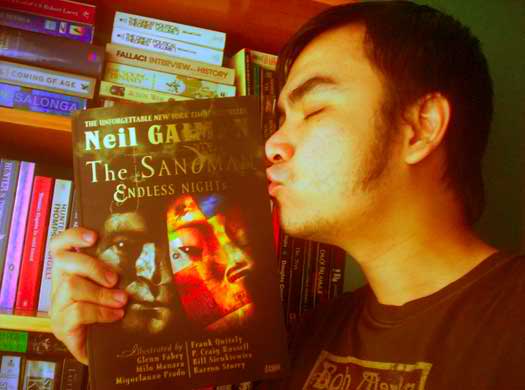
Sandman: Endless Nights - Neil Gaiman

1 comments
The Sandman: Endless Nights is a follow-up to the Sandman series written by Neil Gaiman. It depends if you want to try the Sandman series you may try reading this first as to get a glimpse or an idea about the whole Sandman story.


*****
In "Endless Nights" Gaiman wrote seven chapters, each devoted to one of the Endless, a family of brothers and sisters ( namely Dream, Death, Desire, Despair, Delirium, Destiny and Destruction ).

It was his way of telling their own story in relations to the different representations of the aspects of life.

Each tale is stylistically written in a different way, and allows Gaiman to work with different talented artists like Milo Manara, Miguelanxo Prado, Glenn Fabry to name a few.

****
"Death and Venice" tells the story of a man's encounter with Death and how he helps her open a door to a world in a different time. This is probably my favorite chapter of the book

"I shall see her again, i know that in my heart, one last time..Until then i shall continue to send people to her"

"What I've Tasted of Desire" is tragic love story of a woman who "wants like a forest fire." The object of her desire is the chieftain's son. They eventually became lovers until a horrible event made the story turn darker. Desire who is neither man or woman is intelligently portrayed through the art renderings of Milo Manara.

"The Heart of a Star" Neil Gaiman takes us to one of the earliest Endless tales, here Dream is seen with one of the very first woman he ever loved. Readers will have a glimpse of the Endless world. While Dream introduces his girl to his other siblings like Desire and Delirum.

"Fifteen Portraits of Despair" isn't really a narrative but a collection of portraits made by Barron Storey, designed by Dave McKean with each image being represented by bits of text that narrates every moments of Despair, like the man who losses his job and continues to pretend to his wife to still have one, a young woman who killed herself and so on, it is as Dark as any one can expect.

"with this pain, i thee feel..."Her kiss is the black dog that follows you in the darkness"

"Going Inside" is a multi facet story that revolves around Delirium, it tells the story of a rescue mission involving a young girl by the most uneven host of characters.

"On the Peninsula" Delirium agrees to help his brother Destruction to dig in an excavation site that they believe lies hidden underneath is the Future.

"Endless Nights" doesn't tells a story because as how it goes only Destiny knows our stories and so on and on. And everything is written in a book he carries all the time. The Artwork by Frank Quitely in this chapter is by far the best among the rest in this book, that is if you will ask me.

*****

This is a must read for Sandman fans, and helps first time readers a wonderful start for those who would like to try out Neil Gaiman's graphic work but were doubting about collecting the ten-book series.

Read More »